
Phone housing repair is the process of fixing or replacing the structural chassis of a smartphone, including the frame, back cover, and front bezel, to restore the device's physical integrity and function. This is not the same as snapping on a new protective case. The housing is the mechanical skeleton that holds your logic board, battery, cameras, and sensors in precise alignment. When that structure is compromised, your phone's performance follows. This guide covers what phone housing repair involves, what causes the damage, how repairs are done, and what you should expect to pay.
What is phone housing repair and why does it matter?
Phone housing repair involves repairing or replacing the structural components of a smartphone, specifically the chassis, back panel, and front covers that anchor every internal module. This is the mechanical foundation of your device. The housing is not decorative. It positions the logic board, battery, antennas, and camera array so they function correctly together.
Most people confuse housing repair with buying a new phone case. A case sits on the outside. The housing is the phone itself. When the housing cracks, bends, or warps, the internal components lose their precise positioning. That misalignment causes real problems, from a camera that no longer focuses correctly to buttons that stick or stop responding entirely.
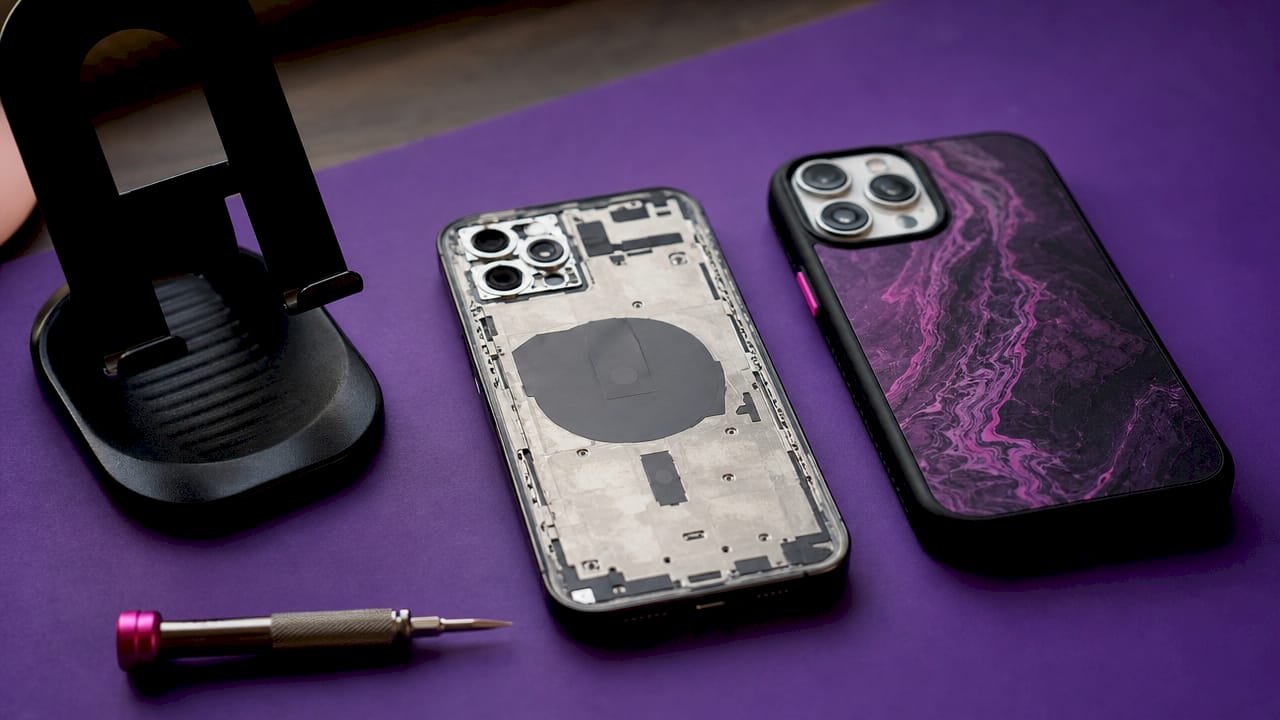
The repair process ranges from minor surface fixes to full structural replacements that require transferring every internal component to a new chassis. Tools involved include heat guns, precision screwdrivers, adhesive applicators, and OEM-grade replacement parts. Phones like the iPhone SE 2022 and Samsung Galaxy S24 series each require specific workflows due to their unique construction. Understanding what housing repair actually means helps you make smarter decisions about your device.
What components make up a phone's housing and frame?
The structural housing of a modern smartphone consists of several load-bearing parts that work together to protect and position internal components.
- Mid-frame (chassis): The central structural layer that separates the screen assembly from the back panel. It holds the motherboard, battery, and most internal modules in fixed positions. Damage here affects everything.
- Back cover: On most Android phones, this is a glass or polycarbonate panel bonded with adhesive. On some iPhones, the rear glass is permanently fused to the metal chassis, meaning a cracked back requires a full frame replacement.
- Front bezel: The frame surrounding the display. It supports the screen assembly and protects the edges of the glass.
- Button brackets and port housings: Small structural elements that keep volume buttons, power buttons, and charging ports aligned and functional.
Materials vary significantly by manufacturer. Apple uses aluminum alloy and titanium in premium models like the iPhone 15 Pro. Samsung uses aluminum frames with glass backs on the Galaxy S24 series. Budget phones often use polycarbonate, which is lighter but less rigid. Material choice affects both how the phone damages and how it is repaired. Aluminum dents. Glass shatters. Polycarbonate cracks and flexes.
The housing also plays a direct role in antenna performance. Cellular, Wi-Fi, and Bluetooth antennas are routed along the frame. A bent or cracked frame can interrupt these signal paths, causing dropped calls or weak connectivity even when the screen looks fine.
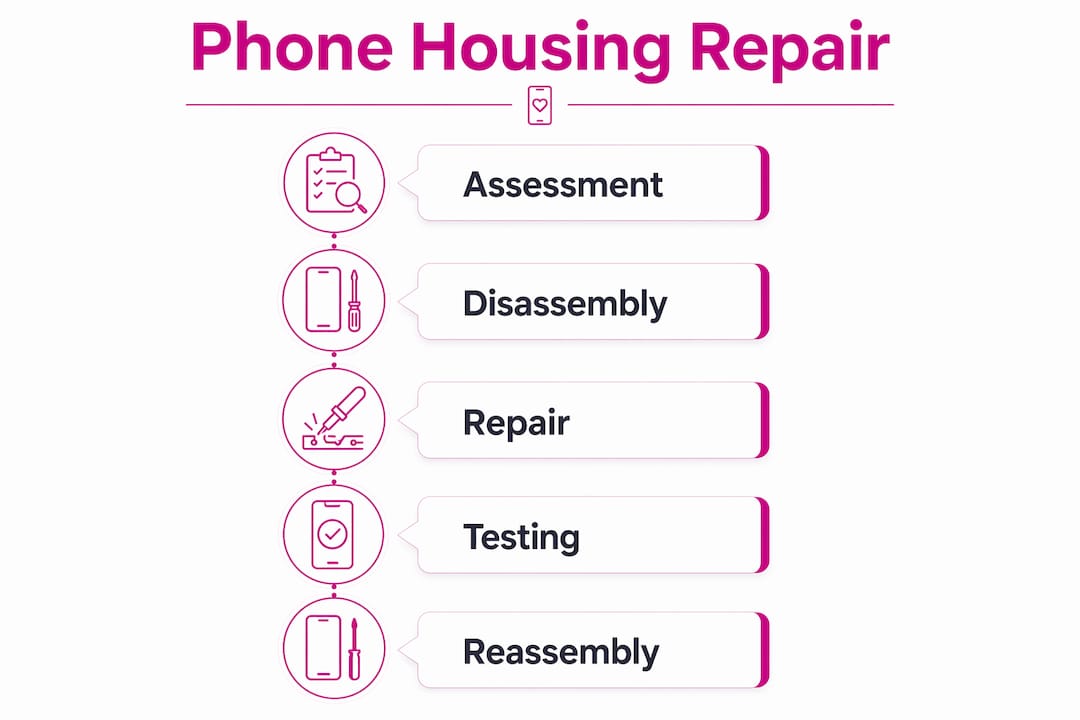
What causes phone housing damage and how do you identify it?
Phone housing damage falls into several categories, and not all of them are obvious at first glance.
- Cracks: Surface fractures in the back glass or front bezel, often from drops. Cosmetic at first, but they expose internal components to dust and moisture.
- Dents and deformation: Impact damage to metal frames that changes the shape of the chassis. Even a small dent near a corner can shift internal component alignment.
- Warped or bent frames: Common after sitting on a phone or dropping it at an angle. A bent frame causes ongoing internal stress that can lead to delayed screen failure weeks after the original incident.
- Loose buttons: Caused by bracket damage inside the housing. The button itself may be fine, but the structural mount has shifted.
- Charging port misalignment: When the frame warps, the port housing shifts. Cables fit loosely or not at all.
Pro Tip: If your screen develops dead zones or display lines weeks after a drop, a bent frame is likely the cause. The damage was structural, not just cosmetic, and it has been pressing on the display assembly ever since.
Hidden damage is the most dangerous category. A phone that looks fine after a drop may have a subtly bent chassis that is slowly compressing the battery or display connector. Continued use without repair can turn a $80 frame fix into a $300 screen and battery replacement. Early diagnosis by a professional saves money and extends device life.
How is phone housing repaired? Methods and complexities
Repair methods depend entirely on the type and extent of the damage. There is no single approach.
- Surface crack repair: Small cracks in the back glass can sometimes be stabilized with UV-cured adhesive. This is a cosmetic fix, not a structural one. It prevents the crack from spreading but does not restore the original strength of the panel.
- Back panel replacement: For phones with removable or adhesive-bonded back covers, the damaged panel is heated to soften the adhesive, carefully lifted, and replaced with a new panel. This is a moderate repair requiring heat guns and thin pry tools.
- Full frame replacement: Required when the mid-chassis is bent, cracked, or structurally compromised. This is a component transplant. Every internal part, including the motherboard, battery, cameras, and flex cables, is removed from the damaged frame and reinstalled in a new one.
- Laser glass removal: For iPhones where the rear glass is fused to the metal chassis, specialized laser equipment separates the glass without replacing the entire frame. This is a professional-only procedure.
- Adhesive resealing: After any housing repair, waterproof adhesive must be reapplied around all seams. Factory IP ratings are difficult to fully restore, but proper resealing significantly reduces moisture risk.
| Repair type | Skill level | Approximate cost | Water resistance restored? |
|---|---|---|---|
| Surface crack stabilization | Beginner | $10–$30 | No |
| Back panel replacement | Intermediate | $50–$180 | Partially |
| Full frame replacement | Expert | $100–$300+ | Partially |
| Laser rear glass removal | Professional only | $150–$250 | Yes, with resealing |
Pro Tip: Always test-boot the device with the screen temporarily connected before applying final adhesive. This pre-seal test confirms all connections are correct and saves you from reopening a fully sealed phone.
DIY full frame replacements carry serious risks. Battery puncture during removal can cause thermal runaway. Flex cables tear easily if lifted at the wrong angle. Micro-screws strip with minimal overtorque. The repair complexity of housing replacement puts it firmly in expert territory for most phone models.
What are the typical costs for phone housing repair?
Repair costs vary based on phone model, damage severity, and whether you use an official service center or a third-party repair shop.
For iPhone rear glass, official Apple repair costs range from $159 to $199. Third-party shops typically charge $50 to $180 depending on the method used and the specific model. The price difference reflects labor, parts sourcing, and whether the shop uses OEM or aftermarket components.
For Android phones like the Samsung Galaxy S24 series, frame replacements at authorized service centers can exceed $200. Independent shops often offer the same repair for $80 to $150, though parts quality varies.
Key factors that affect your final cost:
- Phone model: Newer flagship phones cost more to repair due to part availability and complexity.
- Damage extent: A cracked back panel costs less than a full bent-frame replacement.
- Parts quality: OEM parts cost more but fit better and last longer than generic alternatives.
- Warranty inclusion: Reputable shops include a 90-day or longer warranty on housing repairs. Always ask.
- Water resistance restoration: Shops that properly reseal with quality adhesive charge more, but the added protection is worth it.
One useful comparison: if your phone is worth $200 on the resale market and the housing repair costs $180, replacement may make more financial sense. If the phone is a recent flagship worth $600 to $800, a $120 frame repair is a clear win. You can review repair vs. replacement costs to benchmark pricing before committing to a service.
When should you repair versus replace your phone housing?
The decision comes down to damage type, device value, and how the damage is affecting daily use.
Repair the housing when:
- The frame is bent or cracked but the internal components are intact
- Button misalignment or charging port issues are traced to housing deformation
- The back glass is cracked but the screen and internals work correctly
- The phone is a recent model with strong resale or personal value
- A professional diagnosis confirms the damage is isolated to the housing
Consider device replacement when:
- The housing damage is accompanied by motherboard or screen damage that multiplies repair costs
- The phone is more than four years old and parts are scarce
- Repair cost exceeds 60% of the device's current market value
- Multiple housing repairs have already been performed on the same device
A cracked phone screen combined with housing damage is a common scenario where professional diagnosis matters most. What looks like two separate repairs sometimes shares a single root cause, a bent frame pressing on the display. Fixing the frame alone may resolve both issues. Skipping the diagnosis and replacing only the screen often leads to the same screen failure within weeks.
Key takeaways
Phone housing repair restores the structural chassis of a smartphone, and skipping it after frame damage leads to compounding failures that cost far more to fix later.
| Point | Details |
|---|---|
| Housing is structural, not cosmetic | The chassis anchors the logic board, battery, and antennas. Damage affects function, not just appearance. |
| Bent frames cause delayed failures | A warped frame creates ongoing pressure that can destroy a screen weeks after the original drop. |
| Full replacement is a component transplant | Severe damage requires moving every internal part to a new chassis. This is expert-level work. |
| Water resistance is rarely fully restored | Resealing after repair reduces moisture risk but does not recover factory IP ratings. |
| Cost depends on model and method | iPhone rear glass repair ranges from $50 to $199. Full frame replacements can exceed $300 on flagship models. |
What I've learned from watching people wait too long on housing repairs
I have seen the same pattern repeat itself more times than I can count. Someone drops their phone, the back cracks, the frame bends slightly, and the screen still works. So they wait. Two months later, they are back with a dead display, a battery that swells, and a repair bill three times what it would have been.
The instinct to delay makes sense. If the phone still turns on, the damage feels minor. But the housing is not just a shell. It is the structure that keeps every component under the right amount of pressure and in the right position. When that structure is off, even slightly, the internal parts start to wear against each other in ways they were never designed to handle.
The other thing people underestimate is the water resistance issue. A lot of folks assume their IP67 or IP68 rating still holds after a crack. It does not. The moment that seal breaks, moisture has a path in. I have seen water damage show up weeks after a housing crack, in a phone that never went near water, simply because humidity found its way through a hairline fracture.
My honest advice: get a professional assessment the same week you notice housing damage. Not because every crack needs an expensive repair, but because you need to know what you are actually dealing with. A $90 frame fix today beats a $350 screen, battery, and corrosion repair in three months.
— Gwensheca
Get your phone housing repaired right the first time

If your phone has a cracked back, bent frame, or misaligned buttons, The-tech-savvy-gal in Denton, TX has the tools and expertise to fix it correctly. The team uses OEM-quality parts and professional-grade adhesives to restore your phone's structural integrity, not just its appearance. Every housing repair service comes backed by a warranty, so you leave with confidence. Same-day repairs mean you are not without your phone for days. Whether you need a back panel swap or a full frame replacement, The-tech-savvy-gal handles the job with care and honest pricing. Stop by or reach out to get a fast quote on your repair today.
FAQ
What is phone housing repair exactly?
Phone housing repair is the process of fixing or replacing the structural chassis of a smartphone, including the frame, back cover, and front bezel. It restores the mechanical foundation that holds internal components like the battery, logic board, and cameras in correct alignment.
Is phone housing repair the same as replacing a phone case?
No. A phone case is an external accessory that snaps onto the outside of the device. Phone housing repair addresses the structural body of the phone itself, the parts that are permanently part of the device's construction.
Can I do phone housing repair myself?
Minor back panel replacements are possible for experienced DIYers with the right tools. Full frame replacements are expert-level repairs that involve battery and flex cable handling, and mistakes can cause serious damage. Professional service is strongly recommended for anything beyond surface-level fixes.
Does phone housing repair restore water resistance?
Opening the housing breaks the factory seal. Professionals can partially restore water resistance by applying replacement adhesive, but original IP ratings are rarely fully recovered. Manage your expectations accordingly after any housing repair.
How much does phone housing repair cost?
Costs range from $50 for a simple back panel swap to over $300 for a full frame replacement on a flagship model. You can also check iPhone back glass options for a breakdown of repair strategies and pricing by method.